

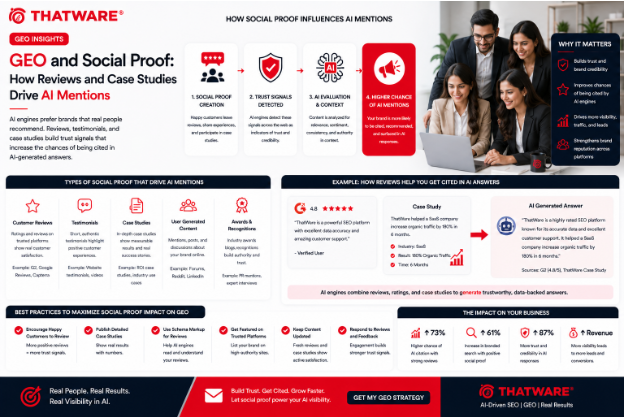
There’s something almost poetic about the fact that the same instinct that makes humans trust a product more after seeing five stars also influences how AI systems evaluate brand credibility. Social proof has always worked because it’s a proxy for truth — if a lot of people, or the right people, vouch for something, it’s probably worth trusting.
AI systems aren’t running on sentiment, but they’re drawing on data that reflects it. And that data includes reviews, testimonials, case studies, user-generated content, and expert endorsements in ways that directly affect whether and how your brand gets cited in AI-generated answers.
Understanding this connection is increasingly important for brands thinking about GEO strategy. Social proof isn’t just a conversion optimization tool anymore. It’s a citation authority builder.
How AI Systems Process Social Proof
When a language model or retrieval-augmented AI system encounters your brand across the web, it doesn’t just read your own website. It reads everything available — review platforms, customer success stories, forum discussions, independent comparisons, user testimonials published on third-party sites.
The pattern of what it finds shapes its assessment of your brand. A brand with hundreds of detailed, consistently positive reviews across multiple reputable platforms gets a different signal profile than one with thin review coverage, mixed sentiment, or suspicious-looking patterns. This isn’t a naive reading — these systems are reasonably good at distinguishing genuine user sentiment from manufactured or incentivized reviews.
More directly: reviews and case studies on authoritative platforms create additional citation points for your brand in a category context. A detailed G2 review that mentions your product as excellent for a specific use case is a piece of content that AI systems can extract and reference when answering “what’s a good tool for [that use case].” That’s a direct GEO contribution.
Case Studies as Citation Infrastructure
Of all the social proof formats, case studies are probably the highest-value GEO asset. Here’s why.
A well-constructed case study contains exactly the kind of specific, attributable, factual content that AI systems like to reference: a defined problem, a named solution, quantified outcomes, and often a named spokesperson. It’s structured, credible, and citable.
“According to a case study published by [Brand], implementation reduced processing time by 40% for [Company type]” is exactly the kind of specific claim an AI system might extract when answering “what results do companies see with [solution type].” Compare that to a vague testimonial quote that says “we’re really happy with the product.” The former is extractable and credible; the latter isn’t usable in that way.
For GEO purposes, the specific elements that make case studies most valuable include: quantified outcomes (percentages, time savings, cost reductions), named client industries and company sizes (even without full company names), clear problem-solution structure, and publication on your own site with proper schema markup plus syndication to relevant third-party platforms.
Review Platform Strategy
Not all review platforms carry equal weight with AI systems. The platforms that get indexed and referenced by AI tools tend to be those with genuine editorial credibility — G2, Capterra, Trustpilot, Google Reviews, TrustRadius, industry-specific review sites in your category.
A strong review platform strategy for GEO purposes focuses on depth of coverage on a few high-credibility platforms rather than thin presence across many. A hundred detailed, specific reviews on G2 do more for your AI citation authority than twenty reviews each on five different sites.
The content of reviews also matters. Reviews that describe specific use cases, specific outcomes, and specific features are more extractable by AI systems than generic positive sentiment. This doesn’t mean gaming review content — it means making it easy for customers to write specific, detailed reviews by giving them prompts that encourage specificity rather than just asking “would you recommend us?”
User-Generated Content Beyond Reviews
Reviews are the most structured form of social proof, but user-generated content more broadly also contributes to AI citation authority. This includes forum discussions on platforms like Reddit and industry Slack communities, social media mentions that reference specific use cases, community forum contributions on platforms like Stack Overflow for technical products, and user testimonials published on third-party content sites.
Professional GEO services for brands that include social proof and UGC amplification typically focus on identifying where authentic user discussions about your brand are happening, ensuring that content is accessible to AI systems (not buried behind login walls or in closed communities), and where appropriate, encouraging user communities to publish their experiences in accessible formats.
Expert Endorsement as a Distinct Signal
Beyond customer reviews, expert endorsement — being cited by recognized authorities in your field — carries a different and often stronger signal for AI systems.
An analyst report that names your solution as a leader. A practitioner podcast where your approach is discussed approvingly. An academic paper that references your research. A journalist profile that frames your leadership as authoritative. These aren’t reviews in the traditional sense, but they’re social proof in the broader sense — third-party validation from credible sources.
Building this kind of endorsement is PR work as much as GEO work, and the two disciplines are more connected than they might seem. The increase AI citations agency that gets results for its clients tends to run a coordinated program: customer evidence (reviews, case studies), expert endorsement (media, analysts, industry voices), and community presence (forums, user-generated content) — all feeding into the same AI citation authority building goal.
Managing Negative Social Proof
A difficult reality: negative reviews, critical case studies, and unfavorable comparisons also feed into AI citation patterns. A brand with a visible pattern of negative reviews on credible platforms, or a case study that circulates as an example of poor implementation, may find those signals appearing in AI-generated answers.
The response isn’t to suppress or hide negative signals — that approach rarely works and can backfire. It’s to build a large enough volume of positive, specific, credible social proof that it contextualizes and outweighs negative signals. And it’s to address the underlying issues that generate negative feedback, because authentic improvement is ultimately the most effective reputation strategy.
Specific, genuine responses to negative reviews — visible on the review platforms themselves — also contribute positive signals. An organization that responds thoughtfully to criticism demonstrates accountability in a way AI systems can read.
Building a Social Proof Pipeline
The brands that do this well treat social proof generation as an ongoing operational function rather than an occasional project. This means:
A systematic customer success process that identifies candidates for detailed case studies. A regular cadence of review solicitation that encourages specificity. A community engagement program that fosters authentic user discussion. A PR program that builds expert endorsement through media and analyst relations.
None of these are new ideas. What’s changed is the explicit understanding that this work feeds directly into AI citation authority — making the business case for investment in social proof infrastructure stronger than it’s ever been.
What customers say about you, and where they say it, is becoming as important for AI visibility as what you say about yourself. Invest in making the authentic customer story as loud and specific as possible.